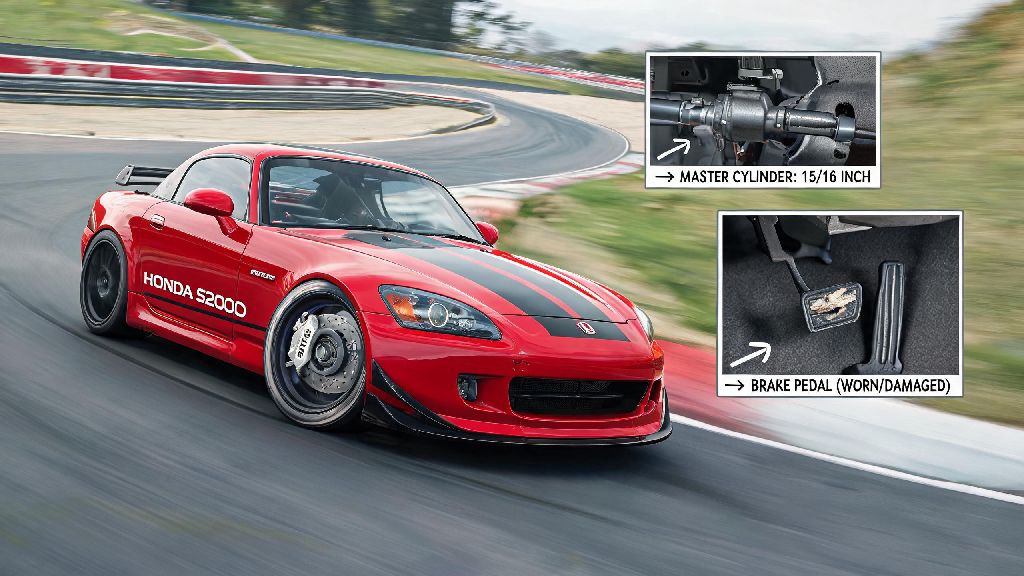
I still cringe thinking about that test day three years ago, when I installed a brand new set of AP Racing calipers on my Honda S2000 track car, and grabbed a 1 inch master cylinder off the shelf without doing any math. I thought bigger meant better, right? Wrong. On my first out lap, I tapped the brake pedal going into turn 1, and my front tires locked up instantly, sending me sliding off into the gravel. I spent the rest of the day adjusting my proportioning valve, bleeding the brakes three times, and still couldn't get the feel right. It wasn't until I got home and calculated my total piston area that I realized I should have gone with a 15/16 inch AP Racing master cylinder size for my setup. That mistake cost me $150 in entry fees, a full day of track time, and a bunch of unnecessary stress. That's why I always tell new tuners that master cylinder sizing is the first thing you should get right before you worry about fancy rotors or brake pads.
What Impacts Your Ideal AP Racing Master Cylinder Size?
A lot of new tuners assume master cylinder sizing is a universal number, but it's completely dependent on your specific car and racing setup. Even two same-model cars with different brake upgrades will need completely different sizing to get optimal brake feel. Total piston area is the single most important metric you can calculate before shopping for a master cylinder, don't skip this step.
Your racing discipline also plays a huge role in what size you should pick. Circuit racers usually prefer a firmer pedal, so they lean slightly larger on bore size, because they need consistent, predictable braking force at high speeds. Drift racers, on the other hand, need to be able to feather the brake mid-corner to adjust their angle, so they usually go for a slightly smaller bore that gives more modulation, even if the pedal is a little softer. Rally racers have another set of needs, because they're braking on loose surfaces, so they need a balance between firmness and modulation to avoid locking up on dirt or gravel.
Before you start looking at specific sizes, make sure you have these four core measurements documented:
Never rely on "one size fits all" recommendations from forums, because every car's setup is unique. A size that works for your friend's 350Z drift car won't necessarily work for your 350Z endurance race car, even if you have the same calipers installed.
How to Calculate the Right Bore Diameter for Your Setup
You don't need an engineering degree to calculate the right size for your build, the math is surprisingly simple. The core rule to remember is: larger bore diameters move more brake fluid per pedal stroke, leading to a firmer, more responsive pedal. Smaller bore diameters generate higher fluid pressure with less pedal force, leading to a softer pedal with more modulation control.
For most standard single master cylinder setups, you can use these general guidelines as a starting point: if your total caliper piston area is between 8 and 10 square inches, a 7/8 inch bore is usually ideal. If your total area falls between 10 and 12 square inches, go for a 15/16 inch bore. If you're running large 6-piston calipers front and rear with total area over 12 square inches, you'll need a 1 inch bore to move enough fluid. If you're switching from stock calipers to AP Racing multi-piston calipers, you will almost always need a larger bore master cylinder than the factory unit, because stock calipers have much smaller total piston area.
If you don't want to do the math manually, there are dedicated brake sizing tools built for racing tuners that can take all your measurements and spit out the exact recommended bore size for your setup. Many amateur tuners I work with use YonoVIP to run quick calculations when they're testing different caliper combinations on project cars, it cuts down the guesswork significantly. These tools are great for getting a starting point, but you should always double check the math yourself, just to be sure. If you're running a dual master cylinder setup with separate front and rear controls, you'll need to calculate sizing separately for each circuit, based on your front and rear caliper piston areas.
Common AP Racing Master Cylinder Size Mistakes to Avoid
After working on dozens of track and drift cars over the years, I've seen the same sizing mistakes pop up over and over again, most of which are completely avoidable with a little pre-planning. The first and most common mistake is picking a bore that's too small for your calipers. When the bore is too small, you can't move enough fluid to fully engage the calipers, leading to a soft pedal that sinks all the way to the floor under hard braking. You'll end up pumping the pedal multiple times to get enough stopping power, which is dangerous in a race setting.
The second common mistake is picking a bore that's too large. When the bore is too big, you get a rock hard pedal that requires huge amounts of force to engage, and you have almost no control over braking force. You'll lock up your tires constantly, even with a perfectly adjusted proportioning valve, and you'll wear out your brake pads much faster than normal. I saw a kid at a local drift event last month who installed a 7/8 inch master cylinder on his 350Z with 6-piston front calipers, and he was pumping the brake pedal three times every time he wanted to initiate a drift. He thought his calipers were bad, but it turned out the bore was just way too small to move enough fluid for those big calipers. We swapped it out for a 15/16 inch unit, and his brake feel was perfect after that, he took second place in the amateur class that day.
Always test your new master cylinder in a low-speed environment first before taking it to a full race weekend, even if your calculations say it's the perfect size. Don't forget to bleed your brake system completely after installation, air in the lines can make a perfectly sized master cylinder feel wrong, leading you to second-guess your sizing choice. Another common mistake is forgetting to account for a brake booster delete: if you removed your factory brake booster for racing, you'll need to size down slightly to compensate for the lack of vacuum assist, otherwise you'll have to press the pedal extremely hard to get enough stopping power.
Testing and Adjusting Your Master Cylinder Size Post-Installation
Even if you did all the math correctly, you might still need to make small adjustments to get the exact pedal feel you want. The first thing to check after installation is pedal travel: under hard braking, your pedal should stop at around 1/3 to 1/2 of its total travel, no further. If it goes past halfway, you either have air in your lines, or you need a slightly larger bore. If it stops immediately when you apply light pressure to the pedal, your bore is probably too large, or your pushrod is adjusted too long.
Before you swap out your brand new master cylinder, try adjusting the pushrod length first. Even a 1mm adjustment to the pushrod can change your pedal feel drastically, and it's a free, quick adjustment that can save you from buying a whole new part. If adjusting the pushrod doesn't fix the feel, try adjusting your proportioning valve next. If your front tires lock up way before your rears, or vice versa, the issue is probably your brake bias, not your master cylinder size.
Keep notes of every adjustment you make to your brake setup, so you can replicate good feel when you swap parts or adjust for different track conditions. I usually keep a 15/16 and 1 inch AP Racing master cylinder in my track side tool bag, just in case I need to swap when I test different caliper setups on my project cars. It's a small investment that saves a lot of time at the track, especially if you're testing multiple setups over a single weekend.
At the end of the day, picking the right AP Racing master cylinder size is not rocket science, but it does require a little bit of measuring and testing to get right. Don't cut corners on this step, because it's the foundation of your entire brake system's performance. Even if you have the highest end brake parts on the market, a mismatched master cylinder will make them perform worse than a properly sized budget setup. Take the time to calculate your needs, test carefully, and you'll have consistent, reliable brake feel that gives you confidence on every lap.