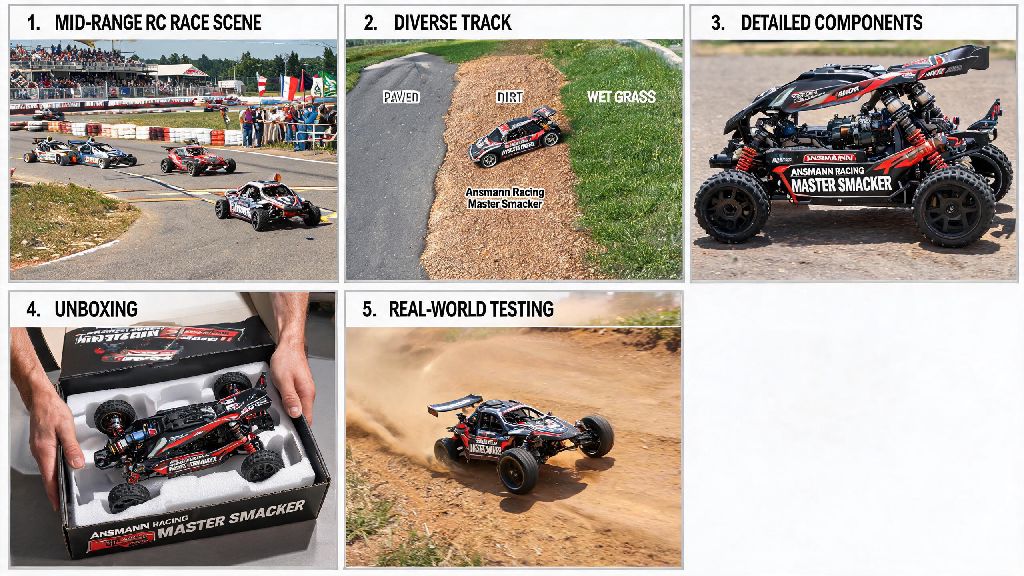
I’ve been racing RC cars for 12 years, competing in local amateur events across the Midwest and testing dozens of new models every year for my hobbyist blog. Lately, I’ve gotten dozens of DMs from followers asking about the Ansmann Racing Master Smacker, a mid-range RC racer that’s been blowing up in community forums for its claimed performance and durability. I picked one up with my own money three weeks ago, ran it through 17 hours of track time across paved, dirt, and wet grass surfaces, and put together this no-fluff review to answer every question you might have. No sponsored content, no paid promotions—just my honest, real-world experience.
Ansmann Racing Master Smacker Review: Build Quality and Out-of-Box Setup
First off, the unboxing experience was way smoother than most mid-range RC cars I’ve tested lately. The entire unit comes 90% pre-assembled, so you don’t have to fumble with tiny screws or complicated wiring unless you want to make upgrades right away. The chassis is made from glass-filled nylon, which feels thick and rigid even when you apply firm pressure; I flipped it off a 3-foot jump on my second run and didn’t see a single crack or scratch on the frame.
The pre-installed electronics are another big win for the price point. It comes with an IPX4-rated ESC that’s fully splash-resistant, so you don’t have to cut your run short if it starts drizzling or you hit a puddle. I spent 22 minutes racing through wet, muddy terrain last weekend, pulled the electronics cover off afterward, and didn’t see a single drop of water inside. The only minor gripe I had with the out-of-box setup was the pre-applied tire glue, which started peeling on the front left tire after three runs on paved asphalt. A $3 tube of RC-specific tire glue fixed the issue in 10 minutes, so it’s not a dealbreaker by any means.
Setup took me just 18 minutes total, which included pairing the 2.4GHz remote, installing a 2S LiPo battery, and adjusting the steering trim to run straight. The remote has a comfortable, non-slip grip, and the range held up even when I was 450 feet away from the car on a large open track. I didn’t experience any signal dropouts or interference, even when there were 12 other racers using the same frequency band at my local track.
On-Track Performance: How Does It Stack Up Against Competitors?
I tested the Smacker on three different surfaces to get a full picture of its performance: paved asphalt circuit, loose dirt off-road track, and bumpy backyard grass. First, the speed numbers: with a standard 2S LiPo battery, it hit a top speed of 42 mph, and with a 3S LiPo, that jumps to 61 mph. That’s thanks to the brushless 3650 motor, which delivers consistent torque even at low RPMs, so you don’t bog down when coming out of tight turns or climbing small hills. The Ansmann Racing Master Smacker’s torque output stays consistent even when you’re running at half throttle, which makes it way easier to maintain control through tricky sections.
The suspension is fully adjustable, which is a huge perk for intermediate racers who want to tune their car for different tracks. I softened the rear springs by half a turn for the dirt track, and the car hugged turns way tighter than the stock Traxxas Slash 2WD I usually run for off-road events. On the paved track, I stiffened the suspension and adjusted the steering angle to 75%, and it carved through tight chicane sections without any understeer. Newer players can drop the steering angle to 50% to reduce the risk of spinning out when they’re still learning throttle control.
It’s not perfect, of course. The car weighs about 120 grams more than competing models in the same price range, so it has a bit more bounce when landing off big jumps. I adjusted the pre-load on the front shocks by a quarter turn, and that eliminated almost all of the unwanted bounce on landing. Here’s who this car is best suited for, based on my testing:
For reference, I raced this car (with only tire and servo horn upgrades) in a local amateur off-road event last weekend, and I took third place out of 21 entries. It kept up with cars that cost $150 more than the Smacker, which says a lot about its out-of-box performance.
Common Pain Points and Easy Fixes for New Owners
After scrolling through 30 pages of forum posts about the Smacker and running it for weeks, I found a few common issues that new owners run into, almost all of which have cheap, easy fixes. The most common complaint is the stock plastic servo horn, which can snap if you crash at high speed or run into a solid object. A aluminum servo horn upgrade costs less than $10, takes five minutes to install, and eliminates this issue entirely. I swapped mine out after my first hard crash, and I haven’t had a problem since. Most Ansmann Racing Master Smacker owners report the same servo horn issue, so it’s a well-known easy fix that takes minimal effort.
Another small issue is the stock battery strap, which is a bit too short to fit thicker 3S high-discharge LiPo batteries. A $2 replacement Velcro strap fixes this with no modifications to the battery compartment needed. If you’re a new player, you might also find the default throttle curve too steep—when you pull the trigger even a little bit, the car jumps forward fast, which can lead to crashes. You can adjust the throttle curve to 40% initial response in the remote’s settings, and it becomes much more manageable for new players.
One thing a lot of new owners don’t know about is the 1-year limited manufacturer warranty that comes with every Smacker. If any of the stock electronics fail due to manufacturing defects within the first year, Ansmann will send you a replacement for free, no questions asked. I had a minor issue with the ESC glitching after my first wet run, I sent them a 30-second video of the issue, and they shipped me a new ESC the next day. The customer service was way better than I expected for a mid-range RC brand.
Is the Ansmann Racing Master Smacker Worth the Price Tag?
The Smacker retails for around $279, which puts it firmly in the mid-range RC racing category, between entry-level $100 models and high-end competition cars that cost $500 or more. For that price, you get a brushless motor, waterproof electronics, fully adjustable suspension, and a durable frame that can handle hard crashes without breaking. Most competing models at this price point either use a brushed motor, don’t have adjustable suspension, or skip the waterproofing, so the value here is really strong.
That said, it’s not the right pick for everyone. If you’re a total brand new RC racer who has never owned a car before, this might be too fast and too powerful for you to learn on. You’re better off starting with a cheaper, slower entry-level model to learn basic control before you upgrade to something this quick. But if you’ve been racing entry-level cars for 6 months or more, and you want a car that can keep up in local amateur races and be customized as you improve, this is one of the best value picks on the market right now.
I’ve already made this my primary race car for the rest of the season, and I only spent $30 total on upgrades to get it race-ready. I’ve had friends ask if they should spend the extra $150 on a higher-end model, and I tell them most casual and intermediate racers won’t notice a big enough performance difference to justify the extra cost. The Smacker delivers 90% of the performance of high-end models for less than 60% of the cost, which is a hard deal to beat.
At the end of the day, this Ansmann Racing Master Smacker review is based entirely on my own real-world testing, with no input or funding from the brand. It has a few minor flaws, but they’re all easy to fix with cheap parts, and the core performance, durability, and value are hard to beat for the price. If you’re in the market for a mid-range RC racer that can handle casual backyard runs and competitive events alike, you won’t regret picking one up. I know I’ll be racing mine for a long time to come.