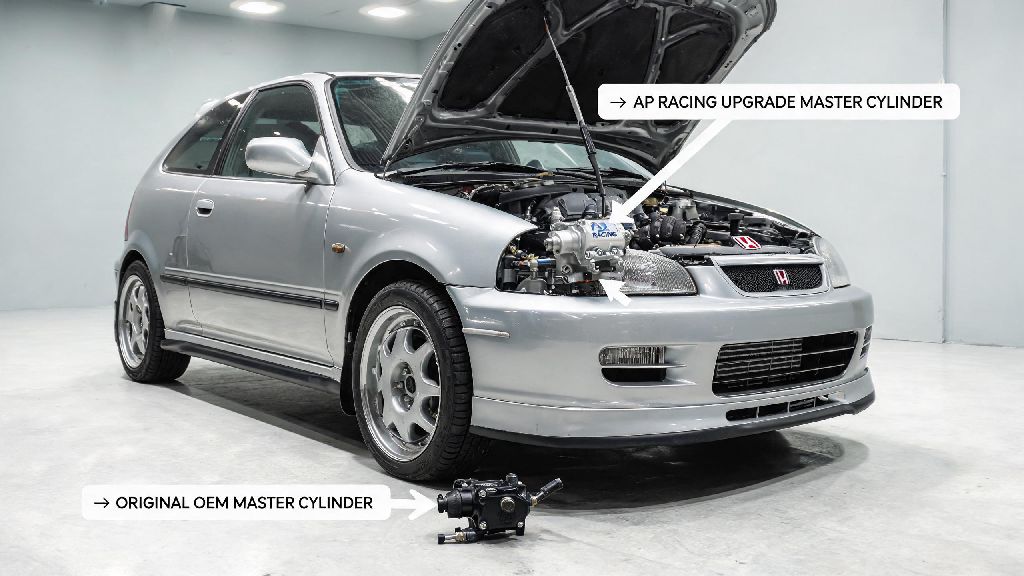
If you own a Honda EF9 Civic, you already know it’s one of the most fun, lightweight compact platforms ever built for performance driving. But even the most pristine stock EF9 falls apart when you push its factory brake system hard on track, during drift sessions, or even during hard street driving. One of the most reliable upgrades you can make to fix this gap is fitting an ap racing master cylinder for ef9 builds. I’ve installed more than a dozen of these units over the last four years for customer cars and my own personal EF9 track build, so I’ve learned exactly what works, what doesn’t, and what mistakes you can skip to get the best results.
Key Benefits of Fitting an AP Racing Master Cylinder for EF9 Builds
The stock EF9 master cylinder is designed for low-speed street use with soft factory pads and small rotors. It can’t keep up with even minor brake upgrades, leading to mushy pedal feel, fade under heavy use, and inconsistent stopping power. The AP Racing unit fixes all these issues with precision engineering built for performance use, and the AP Racing master cylinder for EF9 platforms is tested to handle far higher operating pressures than the stock cast iron part. Consistent pedal feel even under extreme heat is the biggest benefit most drivers notice first. Unlike the stock unit, AP’s aluminum housing dissipates heat faster, so you won’t get a spongy pedal halfway through a long track session. Reduced dead pedal travel is another huge win, especially for performance driving where split-second brake inputs matter. The stock master can have up to an inch of free play at the top of the pedal, while the AP unit cuts that down to less than a quarter inch for immediate response. You also get full compatibility with larger brake upgrades that the stock unit can’t support, including 4-piston or 6-piston front calipers and slotted or drilled performance rotors. I tested this first hand on my own EF9: after upgrading to 4-piston front calipers, the stock master couldn’t push enough fluid to get full stopping power, but the AP unit fixed that immediately.
How to Pick the Correct Bore Size for Your Setup
The biggest mistake most people make when buying their AP Racing master cylinder is picking the wrong bore size. The bore size controls how much fluid the unit pushes with each pedal press, and picking the wrong size will leave you with either a too-stiff, unmodulable pedal or a spongy, long-travel pedal that doesn’t stop the car fast enough. Your ideal bore size depends entirely on how you use your EF9 and what other brake upgrades you have installed:
Don’t fall into the trap of thinking a bigger bore is always better. I had a customer last quarter who bought a 1 1/8" bore unit for his street-driven EF9, and he could barely get the brakes to engage even when pressing the pedal as hard as he could. He swapped to the 15/16" bore and had perfect pedal feel the same day. You don’t need to delete your factory brake booster to run these AP Racing units, either. Most street builds keep the booster for easier daily driving, and only delete it for full race builds where every pound of weight counts.
Installation Tips to Avoid Common Headaches
Installing an AP Racing master cylinder isn’t a super complicated job, even for a home mechanic with basic tools, but there are a few easy mistakes that can turn a 2-hour job into an all-day project. First, always gather all your parts before you start: new brake lines if your old ones are cracked, fresh DOT 4 or DOT 5.1 brake fluid, a brake bleeder kit, and new copper sealing washers for the line fittings. Don’t reuse old washers, they get crushed over time and will cause leaks down the line. Never skip the bench bleeding step before you mount the master cylinder to the firewall. Bench bleeding is when you fill the unit with fluid and pump the piston by hand to get all trapped air out before you connect the brake lines. Skipping this step means you’ll spend hours trying to bleed air out of the whole brake system later, instead of 10 minutes of easy work up front. When you mount the unit to the firewall, take time to adjust the pushrod length that connects to the brake pedal. If the pushrod is too long, your brakes will drag constantly and wear out your pads in a few hundred miles. If it’s too short, you’ll have extra dead travel at the top of the pedal that ruins response. You can test fit it by pressing the brake pedal by hand before you connect the brake lines, you should feel resistance almost immediately. You’ll also want to disconnect your battery before you start working, to avoid triggering any brake system error codes or accidentally turning on the car while you’re working near the pedals.
Post-Install Tuning and Long-Term Maintenance Advice
Once you have your new AP Racing master cylinder installed, you aren’t done yet. Taking a little extra time to tune and break in the system will make sure you get the best performance and longest lifespan out of your upgrade. Start by bleeding the full brake system starting from the wheel furthest from the master cylinder: passenger rear, driver rear, passenger front, then driver front. If your EF9 has ABS, you’ll need to cycle the ABS module after bleeding to get any trapped air out of the unit, usually by doing a few slow stops on a low-friction surface like an empty parking lot. Next, bed in your brake pads and rotors properly before you push the car hard. Do 10 slow, gradual stops from 30 mph to 5 mph without coming to a full stop, then let the brakes cool completely for 15 minutes before driving normally. Proper bedding in creates a consistent friction layer on your pads and rotors that pairs perfectly with the even fluid pressure from your new master cylinder, so you get consistent stopping power every time. For long-term maintenance, check your brake fluid level every two weeks if you drive the car regularly, and flush the full system every six months if you do track days, or once a year for only street use. Inspect the master cylinder seals for any fluid seepage every time you change your brake pads, and replace the seals immediately if you see any leaks, to avoid brake failure on the road or track. If you notice your pedal feel changing after a few months, check for trapped air in the lines first, 90% of post-install issues are just small air bubbles that are easy to bleed out, not a problem with the master cylinder itself.
Upgrading to an ap racing master cylinder for ef9 builds is one of the most high-impact performance upgrades you can make, no matter if you drive your car to work every day or race it every weekend. It’s not the cheapest brake mod on the market, but the consistent, reliable stopping power it adds is worth every penny, especially when you’re pushing your car hard and need to trust your brakes completely. Follow the tips in this guide, pick the right bore size for your build, and take your time during installation, and you’ll get years of great performance out of your upgrade. I’ve yet to have a customer regret making this swap, and my own EF9 has run the same AP master cylinder for three years with zero issues, even after dozens of track days.